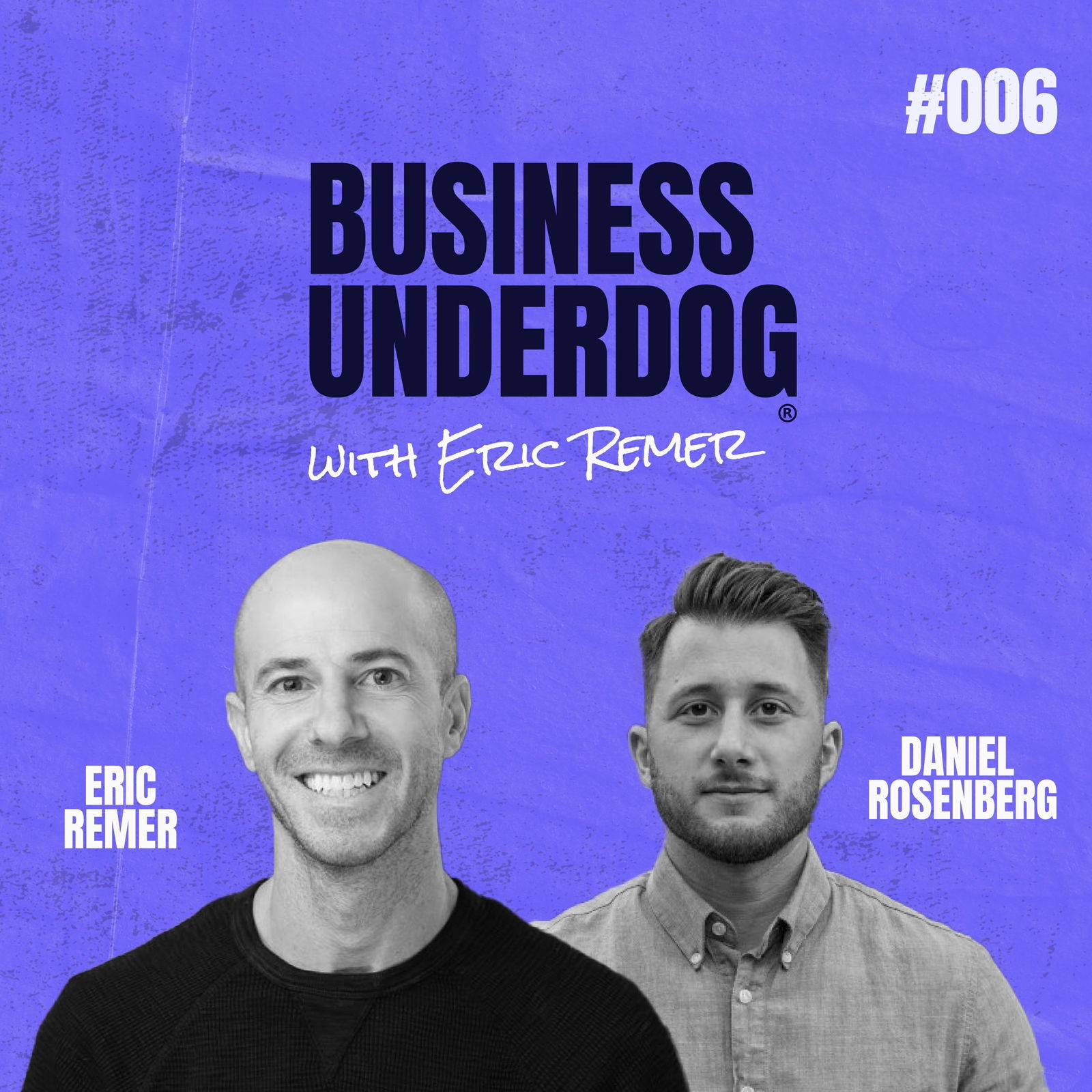
Rebuilding Healthcare with Daniel Rosenberg — Redesigning the System with Empathy and Innovation
Episode Details
Transcript
In this thought-provoking episode, Eric Remer welcomes Daniel Rosenberg, founder and CEO of Compass Pain and Wellness. Daniel shares his deeply personal origin story—one rooted in his mother’s chronic pain and his frustration with a fragmented healthcare system. That experience fueled his mission to reimagine healthcare with a patient-first approach centered on empathy, innovation, and access. From disrupting insurance-driven care models to introducing affordable concierge and regenerative medicine, Daniel reveals how Compass is challenging industry norms. This episode dives into the value of radical transparency, fail-fast innovation, and making bold moves to empower patients and providers alike.
Speaker 0
Eventually, at some point, yeah, I think I just said, I wanna do this for myself. I mean, being a CEO is terrifying, right, because it's all you. The buck stops with you, but at the same time, it's just such a huge opportunity because you feel like you can deliver exactly what you're trying to do. Trying to do. I'm trying to do. Speaker 1
Hello, and welcome to Business Underdog, the podcast where we bring you inspiring stories for the aspiring entrepreneur. I'm your host, Eric Riemer, and I'm thrilled to have you join us on this exciting journey. And today's episode, you're gonna learn as much as I learned from, amazing CEO, Daniel Rosenberg, who has built out Compass Pain and Wellness, now multiple locations and is gonna continue to expand it. What's so cool about what Daniel has created is he's the entrepreneur that came from the outside. He didn't understand anything to do with health care. And then little by little, just by pressing on things and learning more and more and more, found opportunities that not only helped patient care, but really helped his business continue to kinda grow and scale. We're gonna learn lessons of, you know, leadership and culture, challenges that, you know, he had to overcome, you know, and, ultimately, where he is with this business within a health care marketplace that is constantly being disrupted and how he's gonna ultimately grow it. So you can definitely enjoy this episode. Listen. Listen all the way through because we have some good conversations towards the end, and, please enjoy. Well, welcome to Business Underdog. I'm your host, Eric Riemer. And today, I have a a guest, Daniel Rosenberg, who's CEO of Compass Pain and Wellness, and super excited to talk to Daniel today. I'm just getting to know him, but I've I've learned about the story, and I think it's really three main things I'm super excited to get across. You know, number one, how Daniel has reimagined health care, really focused on empathy and innovation within the area that he's focused on. Secondly, Daniel had no background in health care and how he went from kinda really being an outsider to creating a, you know, a a cutting edge, you know, wellness center that is helping hundreds and thousands of patients and has a chance to expand even even even further. And then lastly, learn from all of the insights and lessons to land that, Daniel's had, specifically on leadership, patient advocacy, and some of the entrepreneurial kind of just lessons that he's learned that would benefit to myself and everybody else. So with that, welcome, Daniel. Speaker 0
Hey. Thanks so much for having me. I appreciate it. Somewhat aspirational introduction, but I hope I live up to That's all those things with Compass. Speaker 1
No. You you know, you have. And as you as you and I talked about Friar, yeah, this is why I started Business Underdog. I've talked to people like you that are doing really cool stuff that are making really, you know, real valuable contributions to their community is the people they're they're serving. And so I'm I I feel very fortunate to have you on today. And, you know, I think to kick it off, it'd be really awesome to get your your story, you know, the background of why you did what you did, why you even created Compass. And, you know, just some of the the inspiration behind it would be a great way to kick this off. Speaker 0
Yeah. Yeah. I I just I I love this podcast. I listened to a bunch of episodes before we, you know, when you invited me on, wanted to get the background and everything. And I just I love the framework. And right before we started, you said something great, which was, you know, people should listen to podcasts where whether they're running, you know, whatever, a multimillion dollar company with all these employees and locations or whether they're a plumber with two trucks. And my first, you know, business real real business I tried to run was a carpet cleaning company, and we got up to two trucks. And I thought, this is unbelievable. I have to and I wish I had something like this to listen to candidly because there wasn't a lot of relatable advice, and I was winging it. And I for sure, made a lot more mistakes than successes. Speaker 1
That's awesome. That's awesome. Speaker 0
So this is this has gone better than that. But we we we did well. We cleaned some carpets. But, yeah, you know, I always say I'm the black sheep of my family that didn't go to med school. My father was a pain physician. My mother was a nurse. My stepmom was a pain psychologist. And I just I said, this seems like a lot of work. I don't know that I'm gonna do that. Do the carpet cleaning thing, went to business school, you know, did some startups and early stage finance stuff. And but, of course, like, I just found my way back into the health care space. And I think there's probably a natural gravitation there because even from an administrative, you know, angle or or as an administrator, I can still I still feel like I'm making a difference in somebody's life, and I get kind of the the feeling of of helping somebody by creating a system that maybe allows other people to help them. Like, I'm a conduit to it, and I really value that. And I think that probably does come from, you know, just personal experiences where I think everyone is is, if not themselves, one degree separated from a health care horror story where somebody didn't get the care they needed. You know, maybe in many cases, I think there's an innovative or sometimes non innovative treatment that exists out there that, you know, they just they don't know about because no one ever showed them the path to get to that. And it's just such a devastating thing to be so close to relief and not acquire it because the system is just letting you down. And I I wanna solve that. Mhmm. Speaker 1
Was there a specific moment that you're like, I gotta do this? Like, to your point, you were either, you know, directly or indirectly saw, you know, health care not serving the needs of somebody you cared about. Was that the was there a defining moment, or was it just a kind of a continuation of things you were seeing in the marketplace? Speaker 0
I think I got begrudgingly dragged into health care, originally, and then it kinda built as I was building my career and working at this company, in California as we grew more and more locations. It just started to become a real thing where I was connected to it, and every kind of inefficiency or failure or, you know, opportunity, let's say, of the company to do better became more and more personal. And eventually, at some point, yeah, I think I just said, I wanna do this for myself. I mean, being a CEO and kind of doing it is terrifying. Right? Because it's it's all you. The buck stops Speaker 1
with you. Speaker 0
But at the same time, it's just such a huge opportunity because you feel like you can deliver exactly what you're trying to do. Speaker 1
You know, on that, you know, how is your kind of your personal experience kind of, you know, shaped your philosophy on delivering care for your patients? Speaker 0
I think it's probably a cliche adage, but it's like treat every person that walks through the door like they are your mother, brother, sister, best friend, whatever it is. And I just think if you lead with patient care, if that's the primary focus and you just every conversation you have with clinicians, with staff, with your billing team, everything is like, put yourself in their shoes. You know, again, treat them like that. It just, I think, creates that that culture. And in my experience, everything related to the fundamentals of the business that's gonna show up on the p and l and the balance sheet will flow from that. You'd so it's it's easy to have a North Star. Speaker 1
Imagine that. And and it's obviously so relevant in health care, but it's truly relevant in any business you're doing. Right? If you're treating the if you're treating the customers as if they're, like, family members, you're treating them with kind of the love and care that you would wanna be treated with, I think people are gonna enjoy the experience. I mean, you think about health care, which is so personal. You you it's almost like if you step back and be like, well, of course. Why why isn't that why isn't that the norm? Why isn't that the the norm of what's been done? You know, I I grew up. My father is a physician as well. He's, kinda a general practitioner, and and I would hear his stories for years of people that would come in and, you know, that the the connectivity. And I hit a very similar philosophy that that that you had. Probably didn't take it to the level that you've taken at. So I'd love to hear more about how when you created Compass that you're challenging some of the conventional conventional kind of delivery of medical care. Speaker 0
It it feels like you could pick any single, you know, part of the American health care system and talk for ten hours about how broken it is. Right? I think patients are lost in in a mix of insurance and the bureaucratic elements that that creates and then the way that practices respond to that red tape inefficiently. So it just creates you know, from our perspective, we we named the company Compass because we wanna guide people, guide people through barriers, guide people to the right treatment that exists for them, and kind of offer that emotional path that leads them to where, you know, ultimately, they're gonna get the the best care, the the most relief. And I think that innovation kind of we have to challenge every level of the system. Right? So, you know, can we offer non insurance based treatments at a reasonable price that allows patients to access them, and just circumnavigate insurance entirely? As much as that's possible, I think that that's very much the future of health care. But, also, is there ways for us to build efficiency within our own systems so that we challenge the insurance company model and make them behave more efficiently and uphold their end of the bargain so that patients can ultimately get care? You know, if our contract with an insurer says that they have five days to authorize a treatment and we know that they take sixty days on average, that's unacceptable for the patient. So we have to find, you know, whatever the fine print is and the agreement that allows the patient to access an MRI more quickly because of the carrier's failure to respond. That's better care for the patient. It's really honestly better for the carrier because we know the patient's gonna get treated faster, ultimately utilize less of their resources, be a happier customer to them. But if you don't kinda do that work and you just allow the system to weigh you down, you end up providing bad service to everyone and having a bad business. Speaker 1
You know, I've I've I've been through my own kind of physical journey, and I when I was learning about your organization, I saw all the different modalities that you guys work with. You know, I'd love to understand kind of the multidisciplinary, multimodality kind of mindset of even Eastern, Western kind of, you know, mindsets of how you heal pain and and how you bring those together in a way that the patient's getting the the best care possible, where it's not one size fits all, but the the the variety of different things that could actually create the right solution and how you bring those all together. Speaker 0
Yeah. Pain is a fascinating space. I I think it's the most inherently well, I mean, your father's a general practitioner. Right? So you had to have a lot of tools in the bag. And I think the pain is is in that same element, right, where it's inherently the standard of care is inherently multimodal because pain exists in a physical but also a mental space. It exists in a social space. They said it's a biopsychosocial construct. And so you have to be able to address all of these things. And even within the physical realm, it has to be multidisciplinary. So I remember I had this weird pain in my hip. Like, every time I squat, I just had this weird, like, what is that? And I'm standing in in our office, and I've got three physical therapists and an acupuncturist and four of the best interventional pain docs. And everyone's poking my hip, and they all have a different idea. Right? And, eventually, I wound up in a buddy's office who's a chiropractor, and he's like, lay on the table, pulls my legs, and he's like, dude, one of your legs is like a quarter inch shorter than the other one. Your SI joint's like out of place, and he just pops it in. Right? And I stand up, squat, completely gone. And it's not an advertisement for chiropractic care. Like, it's the end all be all. But when you have a chiropractic issue, someone who sees the human body as an intersection of joint spaces, right, and a skeletal system, that's who you need to see because they that's how they see the world. And similarly, if you have a nervous system problem and you need a, you know, interventional pain procedure or a or a surgery or whatever it is, you kind of need to have the best of the best looking at it from their particular vantage point so that you're able to address and really discover, like, the root cause of the problem. And rarely, if ever, one person is gonna contain all those perspectives. Speaker 1
And and it's it's such a I'm I'm thinking about what you're talking about, how that I'm thinking about that patient who's in pain, who's not you, who doesn't have six people around them poking and prodding them. How do they navigate that journey? Because, you know, great example. You you know, they go, great. I'm going to pain interventionist, and he or she says, this is what you do. And the acupuncture said, no. No. This is what you're gonna ultimately do it, and you had enough, understanding of the overall marketplace to filter through and find a chiropractor to actually, you know, solve your particular problem. How does somebody without that background of the and the the resources that around them find that path to themselves to alleviate that pain? Speaker 0
I think most of the time, they don't. And that's that's really the problem we wanna solve. And, yeah, I've had the feeling I mean, you know, I know some qualified medical examiner physicians. These are just like, I don't know what quality other than thoughtfulness. I think that's the most important quality. Right? Someone who's up to date on all the literature, but they also know how to really listen to you and take in all that information and compare it to the vast knowledge that they have and then think about your situation and be innovative and come up with something. And I just think that that's the rarest quality, and people rarely get access to it. And I I've constantly felt like if I could you know, I have friends, and they'll say, oh, my shoulder this. The doctor said this. I'm like, hold on. Let's FaceTime this doctor I know. Right? And we get on and suddenly they have a total different differential diagnosis, and they go down a different path, and it cures them. And I just that's what creates that burning desire to say, okay. If I could FaceTime every person, I feel like I could get them the best care through the contacts in my phone book. Alright. Well, how do I make a company that just does that for everybody that comes through the door? Speaker 1
You know, we we hadn't really talked about this prior, but I would love to know if at all how you think of utilizing AI to kind of solve some of those problems. Is AI part of Compass's future integrated to any of the kind of modalities or some of the treatment planning that, that may exist? Speaker 0
Yeah. It's a that's an awesome question. AI is something that I spend I mean, it comes up in every meeting, basically. Every day, every meeting, AI is a focus. I don't know you know, it's it's just continuing to solve problems more problems in a better way. I don't think it's there to be fully leveraged yet, but it's obviously what's going to be the game changer. And, primarily, I view it as an administrative, tool. Right? Like, physicians wanna make eye contact and talk to you for an hour in the consult, but then they have to go home and chart that note for an hour in order to get reimbursed by the insurance company. Well, if AI can take that off their plate, they can now see another patient in that hour. Yeah. You know, we do a lot of workers' compensation people who are hurt at work. You know, every single patient visit that we have generates five point five additional incoming requests from fax, physical mail. The mailman just Speaker 1
gives us Speaker 0
a it's so burdensome. And it's designed, I think, to be intentionally burdensome to force people to not wanna treat the patients. Right? Yes. But if you had an AI that could alleviate that, your overhead would go down, and you could invest significantly more in in patient care and see more patients. Speaker 1
You know, just getting to know you, incredibly thoughtful, how you're building your business, focus on the patient, and you're also incredibly focused on building a great company culture. I'd love to learn some of your leadership lessons that you've learned in building out your culture and building out your team because it's awesome. I hear this from entrepreneurs all the time. You care so much. You had this journey with pain management within within your family. How do you bring that throughout your organization, install that same instill that that same level of care between not just you, but you can't touch everybody as we both know as you build your organization, throughout your organization. So each of those patients are having that same type of experience as if they were talking directly to you. Speaker 0
Yeah. It's a great question. I I feel very fortunate for two reasons. One, to be in health care where I think the mission does resonate with people. Like, people move into health care as a career because they they have that empathy internally, and they wanna help people. And so we're as long as we can nurture that and not burn them out and drive them away from it, I think it's there to start with. And then I feel very fortunate to have just incredible, mentor in my career who really led I I'd never really experienced it before where he just led this blameless culture where there'd be a serious issue, like a very bad problem that someone created. And we would get in a meeting, and everybody kinda knew, like, that person made a very bad mistake. But we all cared about them. Like, we know they're trying really. And he would just start the meeting completely problem focused, never highlight that person. Never there's just no reason to because Right. Everybody's on the same page trying to row in the same direction. And I'd I found that to be revolutionary and really I mean, people always say, like, fail fast, fail often. It's like, that's great. It's totally true, but it's you get that outcome so much more. People will take the big swings if they know it's safe to do it, and they're not gonna get friendly fire from their own their own team. Speaker 1
And within that, I'm sure fell fast, you know, fell often is is a great philosophy, but it it does mean you're failing along the way. So what are some of the challenges that you had to face to get to where you are today? What are some of the biggest things that you've had to overcome to kinda create the stability where you now we'll talk about in a second, where you wanna take this organization. I'd I'd love to I'd love to hear about that. Speaker 0
I feel like I'm constantly creating sunk cost and then abandoning it. And that's the that's the failure. So Yeah. As a as an example, we found this tech company that, you know, had these, ideas about integrating with insurance portals and basically making the the authorization process significantly easier. And this is probably the most burdensome area of per like, treating patients who have insurance. It's just trying to get the insurance to tell you you're allowed to do whatever treatment you need to do for them. And it's just enormously expensive, and it takes forever, and it's all this friction. And so we just we invested all this time, and I built this proprietary software application that would link with this other software. And the whole thing just completely didn't work. It just, like, we spent months of doing it, and it was like, oh, this is just no better than a human sitting and processing on the phone trying to do these authorizations. And I could feel internally my tendency was like, well, we have to keep it, though. Right? Because I just spent so much time building it. And it's like, no. It just it failed. It didn't work. It was it was a great idea. I would do it again ten times out of ten with what I knew then. But okay. Just to literally just delete all the code and just move it. Over. Start over. Speaker 1
Well, you know what? It's funny. And you have to deal with it as a small business owner that comes out of your pocket, your profits. And when you make those mistakes, it could be really painful. I'll give you kind of a, a parallel in my world where, you know, we're trying things every single day. You know, every single day, how do we provide more value to our customer? What tools are our customers gonna want? What do we make what do we utilize to it? What do we invest? Utilize the resources we have to invest to create the most value. So I always kinda joke, we'll go to a board meeting, and my board is I have a great board of directors. They're very well intentioned. And they'll be like, okay. Break down all your investments. Show me the ROI in all those investments and why you're gonna do that. And if we do it, you know, we do the kind of background, and we think just like you had an amazing ROI on that product that didn't work, the reality is we don't freaking know. Like, you don't know, which is why you're doing it in the first place. And often takes those chances. You may you you failed on that one. We haven't talked about things that have succeeded yet, but you you have to do one, two, three, four things where, actually, if you if you look back and get a perfect vision of the of the past, you'll say, yeah, those four things are a complete waste of time and energy, but I had to do those four things to find the fifth thing. Right? And so it's never one to one. It's always those trying to do those things, that are gonna really move the needle. You don't always know which one those are gonna be. So it's, it's like I said, we talked about it in the in the intro. It doesn't matter if you're running your business or my business. It's the same type of, you know, challenges that that all entrepreneurs have as they're trying to grow their business. So I I I I appreciate the, the story. So tell me one of those that let's let on the positive side, what are one of those things that you took a big swing and said, you know what? I think this is gonna actually move the needle. And you you invested time, money, resources, and you saw it come to the other side in a real positive way. Speaker 0
Yeah. It's, those are harder to think of. No. I I think the biggest one Speaker 1
is funny you say that because it's never one big swing. If those little things that happen, you do one every day that you look back and be like, oh, shit. We really created something really cool here. So, it's it's you the the fouls are easy because they're one big swings you missed. Right? The most of the successes are are those little incremental movements versus a big big swing. So if you don't have them, that's still, like, Will. Just hope you have you had a big project that worked out really well. Speaker 0
No. Yeah. I can I can think of some? You know, I think, one of the biggest things is is being outcome driven from a data standpoint. So a lot of medical guidelines are based on objective information about patient improvement. Right? And we figured out a way to really track this because that that can be difficult to to demonstrate. As a physician, you know, you're having as a patient, you're coming in, you're talking to your doctor, and, hey. I'm getting so much better. We should keep doing this treatment. You're like, of course. Right? But the insurance company, that's not good enough for them. They need, you know, an objective outcome measure. And so figuring out systems to directly allow patients to communicate, how they're getting better and in what specific ways. And so we created an application that kinda messages patients based on, their individual diagnosis and gives them these standardized assessments so that they're able to say, you know, here's how I'm doing with activities of daily living, or and these are all clinically validated. So the score that the patient generates based on their unique responses is actually a, you know, objective measure. It's not a subjective assessment of how they're, they're how they're feeling or how they think they're improving. And those objective measures then just flow directly into the visit note, and the provider was able to input them at the click of a box, and then it would go with the authorization to the insurance carrier. Speaker 1
Really cool. Speaker 0
And it it just skyrocketed our authorizations and our ability to get patients the care they needed. And we would just bring them into the fold. Right? Hey. Don't forget to take your assessment every month because it's really gonna help us get you the care that you want. Speaker 1
That's awesome. No. That's that's that's a great that's a great example of, of that. You know, speaking of patients and patient care, which you know, how do you balance you know, you're running a business, you know, a for profit business that you're, you know, you're trying to make money and support your family. On the flip side, you went into this to truly provide amazing care for patients. How do you balance running that business, generating kind of the the the the growth and the profits you need to continue to be successful, but also keeping care accessible to people that might have less financial resources than other people? Speaker 0
It's a big challenge. And it's a big challenge, you know, again, where an insurance carrier might make a decision like, hey. You know, we're just gonna cut physical therapy rates by fifty percent. And we have three hundred patients from that carrier who are currently in the middle of physical therapy. And you've suddenly just changed the game where this is this is not profitable. It's not it's not even breakeven. You lose money every single time you see one of these patients. And sometimes you eat it because it's the right thing to do to care for the patient, and I just won't accept the role of of that being put in that position. But you have to innovate around it and, you know, create financial hardships, create other opportunities to collect from that insurance carrier. You know, we're we're venturing into the path of functional medicine, which is, you know, all the cool Andrew Huberman Yep. Biohack. Right? And it's it's a great world. I find it really interesting, but it I think it's also highly inaccessible to most people. And I I don't like that. And, you know, I think we're gonna we're still in the design stage, but I think we're gonna have a scholarship program where for every That's true. X number of applicants or x number of patients we accept, you know, ten percent or something is always maintained as a free program. Be and, you know, that's not that's not amazing, but I think just at least putting the flag in the ground and saying, look. Like, this can't just only be this can be an ivory tower of health care. Yeah. Right? Yeah. Speaker 1
Well, and if you think about, like, I'm I've been I I go to a functional, you know, doctors, just like you provide some concierge services. You provide some concierge services. And to your point, it's not accessible. I have you know, he's given me, you know, peptides and shots, and I'm doing all these things that are very preventative, which if you think about the cost of the health care system, my focus you know, I'm now in my early fifties. I wanna stay the heck away from the health care system. Right? I I wanna do all the things I could do physically, both, you know, that from food to, you know, move movements to ultimately working with functional medical doctors that are giving me things that are gonna keep me away. And if you think about the cost on our system, if those modalities that actually get proven scientifically that actually work, not just the stuff that I think are really cool, get pushed down through the system, not only should it be accessible that everyone has better health care, but it should be less cost on the system because the more preventative, the less, you know, chronic diseases that people are dealing with, which, you know, in the in the industry is weighs down the industry massively. It's those chronic diseases that probably could have been caught and or, you know, mediated at some level prior to getting to that place where it becomes very expensive on the medical system. So, yeah, I'm I'm, I'm I'm well aware of that that world. And and do you see that, you know, as you look at kind of the future of where you're going, what are some of the biggest opportunities? You know? Is it creating better systems within your ecosystem to bring that functional medicine down? Is it, you know, expanding the clinics in different directions? I'd I'd love to see kinda you know, from your perspective, what what are the biggest opportunities within the health care ecosystem? Not even specifically with Compass, just what you see in the health care ecosystem that are gonna be really big breakthroughs going forward? Speaker 0
Yeah. I think you've hit a lot of the nails on the head in this conversation. I think AI is gonna be massively disruptive to cost, which should bring care down. I I don't know if insurance companies will get better at actuarial science, which it seems like they're just not very skilled at this because it feels like if I ran a health care insurance company, I would immediately send, like, a diet and exercise counselor to every one of my members. Right? So that they would use less of my, resources down the line, but they don't seem particularly interested in that kind of stuff. I think that overall as a system, I'd like to see it move more to that concierge model, and I think that that's where it's going. I think retail health, as it's called, is one of the fastest growing segments. I think you look at things like, you know, LASIK surgery or elective surgeries, and they get better, faster, cheaper year over year, and things that stay stuck with a middle person as the payer, like an insurance agent or a network, you know, can get more expensive or just seem arbitrarily costed. And I I think there's just a huge opportunity there for patients to start feeling a little more empowered like consumers and having options. And, yeah, having direct access to care and being more emboldened, less prescriptive. You know, we touched on that earlier with the clinical care, but I think part of that relates to if you just go in and this is the doctor they told me to go see and this person's gonna have the same opinion as everyone else and I'm gonna follow whatever is said. That's less, empowered as a consumer. You would never behave that way trying to buy a TV or a car. Right? You understand the nature of the relationship, and that's not really different in health care, maybe for better or for worse, but I'd like to lean into the better aspects of it. Speaker 1
Yeah. One of the real benefits you get with the direct pay, you're actually paying for the carrier receiving so you care more about it. I mean, if you think about part of the issue with the health care system in general is I don't know the percentage, but my guess is it's a very, very large percentage of health care being paid by people who aren't receiving the health care. Right? Companies are the biggest priority provider of health care. Corporation is the biggest provider of health care in this country, so we pay for health care costs. But the the people who are receiving the treatment are making the the checks out to those organizations. So when you have that disconnect, you know, the incentives are so misaligned, and nobody wins. Well, some people may win, but the ultimate patient, you know and and and, honestly, as you know, with your your family, the doctors don't win either. You know, they don't like the system. They don't like being you know, when my dad, who's who's older now, he finally retired, at the end of his career, he's like, Eric, I'm a gatekeeper. Like, I'm I'm I I don't serve my patients anymore. I have to be a gatekeeper of what insurance they're using, who they could potentially see, what they're gonna do. Even if I know this may be better for them, it's out of my hands at this point in time. And so it it is so interesting when you think about all the, you know, levels that that exist that often make things way more complicated when when if you went out to the to your point, you went out to the store and bought a TV that that used to be five thousand dollars, but because the competition and because innovation, you could buy that same amazing flat screen TV for a thousand dollars today. Like, that's great for me as a consumer. Right? I got a better picture for cheaper dollars, and I'm super happy watching, you know, my football game on Sunday. So it's, it it is we we've seen it in every other aspect of, you know, kind of, consumerism, but but not in health care. So it's it's really interesting. So when you think about, where do you see specifically with Compass? How do you see Compass expanding? How do you see Compass growing over the next, you know, five plus years? Speaker 0
Yeah. I think we're gonna grow we're gonna grow in multiple ways. One way is the service line itself. So at each clinic, we wanna be, you know, fully multidisciplinary, meaning we have every conservative care modality, PT, acupuncture, chiro, psych, in addition to, you know, interventional pain. We do a lot in the realm of orthobiologics or regenerative medicine. This is a huge area of health care that's totally underserved. I mean, we're seeing really unbelievable results, with, you know, stem cells and platelet rich plasma and fibrous rich plasma, you know, fully ruptured tendons that would require massive surgeries and recovery, actually, you know, repairing to the point of no aberrant findings on on an MRI a year post. I mean, this is just the sciences. The the the anecdotal, body of evidence is there and growing, and the science needs to catch up with the studies. We're actually, you know, doing a a formalized randomized placebo controlled clinical trial right now at one of our offices with intradiscal stem cell injections. So trying to be a leader there to to grow that segment. And that's kind of a destination service where for a lot of people, hey. If you can avoid a surgery, like, I'll, you know, I'll travel somewhere to to get that. But, you know, once you kind of have each site incubated with the perfect combination of standard of care where every person that walks through the door, you think you're you're doing everything you can to alleviate their pain and repair their, you know, orthopedic issue or the underlying cause of their pain and not just treat the symptoms, then I think it's about just adding locations and maintaining that standard of quality as much as we can. Speaker 1
Oh, Dan, you know, you think about, you know, just on that note specifically. So I think you have two locations right now and, you know, you you wanna expand beyond that. Every location you start, you're making there's there's costs. Obviously, there's lease and there's build out, and then there's you gotta put people on staff before a patient walks through the door. Every entrepreneur deals with this when they deal with expansion. Right? You know, I'm I'm a h track guy, and I have two trucks on the road. And I think I have the demand for a third truck. And the third truck means I need to hire two more people to manage to be in that truck. So the expenses that are gonna go out before I get that revenue in, how do you kind of manage that kind of thought process? Like, what what is in your mindset to say, you know, I'm gonna put this these dollars into the ground. I know it's gonna be a cost, but here's what gives me confident that that is gonna be a payback when there's no guarantee in anything. I'm just and it's very risky as a, you know, a small business owner entrepreneur. So I'd love to get your thoughts on that. Speaker 0
Yeah. Doing a de novo practice is is a terrifying, you know, it's a terrifying feat. You're just kind of jumping and saying, well, I believe that this area is underserved, and it's gonna value the service that we're gonna provide. We're going to really hope that we get credentialed in these panels because if we don't, we, you know, can't see patients. You know, we launched here in Portland, opened our doors February first, of this of this year, and we're still not in network with some payers and unable to see those. It's just you're just kind of waiting. And so your, you know, your pro formas get kinda skewed when things like that happen. You say, well, I was counting on twenty patients from this. So, yeah, the de novo is is really scary. One way that I've kind of pivoted to overcome that is looking at acquisitions. So looking at very similar businesses, similar practices with people that maybe fit your culture, but the administrative side of their business hasn't been as successful. Maybe they're breakeven or barely breakeven, but there's still existing cash flow there to kinda cover expense. And then you say, hey. I think we'd make a great partnership. Why don't you join our brand? And we can bring some of our innovative technology or best practices to you, which will help reduce cost. And suddenly, you've, you know, you're you're created a profitable entity that has your same culture and is delivering that same standard of care, but you didn't have to take this giant risk with cash flow because you had something coming in to cover it. Speaker 1
That's really interesting. We after the I'd love to talk more about that with you because I think that's super interesting. And, you know, as you know, at EverCommerce, we acquired fifty plus companies over the past, you know, eight years. So I have a lot of experience in in in doing that and going into new markets, utilizing platforms that already existed, and then hopefully take them to the next level, providing even more value. So that's something that I would love to follow-up with you on and, you know, give you some insights that we learned along the way. Speaker 0
As you did that, I mean, acquiring that many as as you acquire that many practices, was it hard to keep a cultural center? Speaker 1
The the answer is, yes. But we, you know, we we really focused on look. Every business I here's how I would look at it. So we go acquire an organization that was, you know, built somewhere else. My view first and foremost was each employee of that organization vibrationally connected with that organization, which is why they work there. So there was something in that within that ecosystem that was important to them. And so my view was let's not break that. I don't wanna break what what what is working for them. What are the things we can do that could accentuate? What are the things we do at EverCommerce that we think are a win no matter what no matter no matter where you are? That could be you know, we always did, like, Friday lunches. This was just as an example. So thing one, we would implement Friday lunches with everybody. I'd be like, oh, that's cool. Like, that's that that's not a bad thing. Right? And then we started getting our our culture team at EverCommerce working with the local culture teams and and really talking about best practices. What are the things that we're doing here that we think we can implement into your organization that will really make people feel comfortable that we're trying to be we're trying to accentuate. We're not trying to alleviate kind of, you know, all older cultures. And and over time, you know, with as turnover happens naturally, then we continue to hire in based on, you know, our views of how this needs to go forward. But we're really thoughtful to not break cultures that existed because, you know, my view with I'm I'm going a little off topic here, but I have this whole concept of conscious culture. And so culture is not good or bad. It's intentional. If you're conscious about it, it's intentional. Right? So, you know, who am I to say my culture is right and your culture is wrong? What I really wanna say is, what are we trying to create here? What is the intention behind the culture that we're trying to create? And then create, systems and infrastructure and events and things around it that back up and solidify that intentional consciousness that we're trying to create eventually. So that's what we really deal with those acquisitions, which is, okay. Great. What do you guys do? What is your culture focused on? What are the outcomes that that culture is trying to create? I use this example all the time. You know, the US army is an incredibly conscious culture. Now you and my you and I may not wanna join the army, either good or bad, but they are incredibly intentional on how they recruit and how basic training, how they train you, how you're out of the field, the hierarchical system to ultimately accomplish their goals. Holy shit is that amazing. Right? So incredibly conscious based on their end intentions they're trying to create. And so I always start from that perspective. What are we trying to create? What are the intentions? What do you have in place that is actually accomplishing those intentions? And what are the things we can do to kind of accentuate that going forward? Speaker 0
I like that. I mean, it's a great starting place to just tell someone, well, I'm not gonna start with telling you what kind of culture you should build, but just say what kind of culture are you building, or do you even think about building? Right. If you start with that intention Speaker 1
now unconscious. Exactly. Speaker 0
Right. Speaker 1
They're not just Speaker 0
kind of the worst one. Speaker 1
It it it's it's a you're a robo in the ocean, and you just you're you're flowing with an effort. So what we've seen in the acquisitions, people are excited to be part of something. They're they're excited to be part of a vision. They're excited to be, you know, they wanna be a part of something that's got got a culture, that's got a vision, that's got somewhere to go, that's got a mission. And if you do it in a way that in, you know, embraces them and not pushing them away, You know, let's look. This isn't you know, we're we're not perfect. You know, we're not, you know, gonna make all the right decisions. But in general, when you go in with the right kind of the right intentions, I think usually good things play themselves out. And I and I think that's been the case with the vast majority of our acquisitions over the years. So to really kinda close-up this, you know, I would love you know, you you went on your own. You started this business, which you didn't know much about at first. You've now opened a second location, and you have visions for beyond there. You know, what advice would you give for, you know, other entrepreneurs that are looking to, you know they see an opportunity. They see, you know, something that is not working in a specific industry they're focused on. You know, how do you kind of advise them to disrupt something or to just do something that hasn't been done before when there's real risk involved with that? Speaker 0
Yeah. It's I mean, it's a scary road to to to be disruptive in general. I think the biggest thing that's helped me overall, and not even necessarily from an entrepreneurial sense, but when starting my health care journey just kind of as a low level manager, is don't assume that anything is the way people tell you it is. There's so many entrenched, right, ideas and, like, you know, I I started in in a lab. That was my job, was grow this laboratory, get more samples. Right? It was kind of like a sales job, a little bit of operations, like a product marketing manager. And I was looking at the billing, and people are like, yeah. You bill it this way. And I'm like, oh, I and I never Speaker 1
even heard Speaker 0
of it. Like, oh, it's a CPT code. I'm like, oh, what? I'm writing it down. CPT. Now it's my entire life. Right? It's based in CPT codes. And it's like, why is that? Why is that? Why is that? And you can obviously drive yourself crazy with this, but if you kinda start pressing on things, sometimes you find you're in a call with someone who really seemed knowledgeable five minutes ago, and suddenly they're like, wow. That's a really good question. I never thought of that. I don't know why we do it that way. Let me get back to you. And before you know it, you found some entirely new inventive way of doing a thing that's, like, incredibly more profitable or efficient or better for patients or whatever it is. And I've kinda found if you press on everything like that, you find a lot more of those than you think. And I think instilling that curiosity in yourself and in those around you is is like the precursor to innovation. And if you wanna disrupt something, I think it's like find a pain point and then press on everything around the pain point, and you might find a better way to solve it. Speaker 1
It's really, really profound great advice that is applicable across any industry and what anyone's doing. So that's that's awesome. Last question, really more for you. I'd I'd love to know about personally what's next for you. You know, you and I talked about you. You have your your old podcast. We may have some some boxing fans on listening to this podcast today. So I I'd love to learn, you know, share share with the audience, kind of what you're doing personally, and and it's, the tell them where they could find your podcast. Speaker 0
Yeah. Appreciate appreciate the plug. Yeah. If anyone's a boxing fan, that's boxing podcast. You know, whenever I get a little free time, we get on there and try to predict some fights and, lose some money on DraftKings. That's my four zero one k right now. If this compass doesn't work out, I've got that going for me. Yeah. It's tough. I mean, I'm sure you've got a lot going on. I'm sure it's tough to find, like, balance in your life. How do you do how do you draw a line between work and anything you wanna do personally? Speaker 1
Yeah. Well, you know, you know, gotta wrap this up. When you do things that you're really passionate about, you know, those things start blending together. Right? Whether I'm working I mean, I'm working right now, Daniel, technically, but this is fun for me. Like, I'm enjoying getting to know you. I'm enjoying this conversation. I'm learning, and I'm better for it. So is this work, or is this fun? I don't know. I mean, I hope we get to talk after this podcast. Right? So, you know, when you can do things you're really passionate about, they do things you really enjoy, those kind of work kind of balance gets blended together, and it allows you to spend more time doing the things you really wanna do, which ultimately have more impactful outcomes for your team, your pay you know, your in your case, your patience. In my case, often our customers, because you're enjoying it. It's not it's not heavy. It's, it's kinda fun. And and it it's reality in every industry, whether it's, you know, whether you're a plumber, you're like, well, some people love plumbing. They love putting a new pipe on, but they they may really genuinely enjoy the the, being strategic about how they, you know, fix something or it was being really thoughtful around how they connect the dots to create the most efficient systems out there or solve problems that no one else has actually solved. So when you're engaged and passionate about what you do, those things kinda take care of themselves. So that's, no. That's I I I appreciate that. So, listen, Daniel, thank you so much. I can't tell you how much I appreciate, your time today, how much I really enjoyed getting to know you and learn about your journey. And and I can't I'm excited to watch the future growth of Compass and and where you take it because you and I both know that that opportunity and the need for what you're providing is absolutely huge. So how do you do it little by little than all at once where more people and more patients get a benefit from the value you bring it to the to the communities and ultimately to the health care ecosystem? Speaker 0
That's definitely our goal. And, hey, thanks for having me on. This was great. Awesome getting to know you and and talking more. And, yeah, thanks so much. Speaker 1
Awesome. Thanks, Daniel. Thank you for joining me on this episode. I'd like to invite you to subscribe to Business Underdog on your favorite podcast platform. By subscribing, you'll never miss an episode, and you'll be the first to hear these incredible stories. Please be sure to follow us on social and visit our website at business underdog dot com for episode updates, resources, and more. And thank you for listening today. Until next time, stay inspired, keep pushing forward, and embrace your inner underdog.