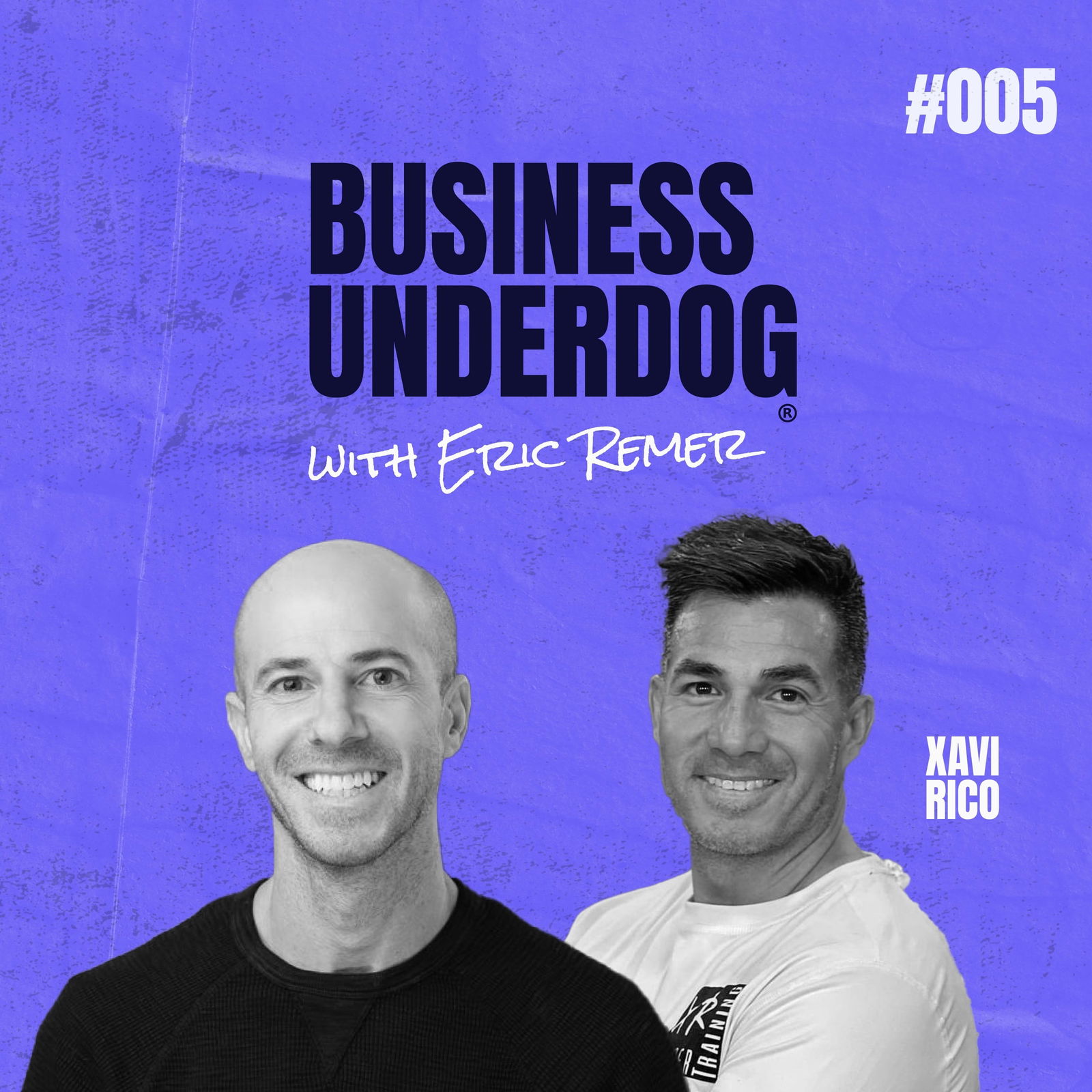
Turning Adversity into Opportunity with Xavier Rico — Building a Brand of Discipline and Detail
Episode Details
Transcript
In this episode, Eric Remer sits down with Xavier “Xavi” Rico, founder and CEO of XR Soccer Training. Xavi shares his underdog journey—from arriving in the U.S. with limited English and few resources to building a thriving youth soccer training business known for its attention to detail, intensity, and international opportunities. He reflects on overcoming early barriers, validating demand after a costly program misstep, and developing a coaching culture that elevates both technical skill and mental strength. Listeners will hear practical lessons on work ethic, brand credibility, smart scaling, and creating community impact.
Speaker 0
That fear, it it was the biggest struggle for me. If I don't if I don't make it, can I still provide for my family? So that was one of the the hardest part is to pull from for something that hasn't been done yet at that time. Can I make a living out of it? It's even at work. It's even at work. Speaker 1
Hello, and welcome to to Business Underdog, the podcast where we bring you inspiring stories for the aspiring entrepreneur. I'm your host, Eric Riemer, and I'm thrilled to have you join us on this exciting journey. Couldn't be more excited about today's episode of business underdog. I'll be speaking with Javier Rico who's truly an amazing entrepreneur, someone who's built something from scratch. And I kinda say turning adversity into opportunity, overcoming all ultimately, like, overwhelming obstacles to create a really thriving, business. And, it's been awesome watching Jave's kind of growth journey coming from Mexico, generating a a school that teaches literally thousands of kids a year, across the world. Mexico and Spain and, you know, Milwaukee and Denver and all those other areas, but it it's pretty incredible, not just the journey, within this kind of soccer academy, but the lessons that I learned from Avi, the leadership lessons of being authentic, leaving with honesty even when parents or kids wanna hear something different. I'm holding true to the things that you care about. Be willing to do the dirty work in the field with the kids to make sure they they earn that respect versus having to fear you. And so I think you're gonna really enjoy it. I've known I enjoyed it. I've known Hobby for a long time, and I learned a lot of new things that are gonna help me in my life and in my career as well. So, looking forward to hearing this episode and listening. And so thanks so much, guys. Hey there. Welcome to Business Underdog. This is your host, Eric Riemer, and I'm incredibly excited to introduce my guest today. This person I've known for many years. I've watched not only, he and build his business from ground up, but really his talent on the field. Javier Rico is CEO of XR soccer training. And as I said, I've watched this evolution of this business, that really just came from an idea. And I also watched the talent as he actually coached my son for many years and and how he provides incredibly value incredible value, not just the kids' development, but the kids' growth as human beings as well. So with that, I'm gonna introduce Javier Rico. Hey, Javier. How are you doing, buddy? Good. How are you? Thanks. I'm doing Thank Speaker 0
you so much for having me. You know, like you said, we know each other for many years and coach GJ's and everything. So I appreciate you having me, and, hopefully, you know, I can help anyone out there. Speaker 1
Awesome. No. Well, you definitely can. I mean, your story is one of turning adversity into opportunity, overcoming overwhelming obstacles where most people would have, quit or not had the, you know, fortitude to continue on. So I think it'd be really cool I mean, really one of the reasons I started Business Underdog is to share these stories. You know, the stories of, you know, entrepreneurs who have built something that didn't exist before, came from circumstances that were hard to overcome, and ultimately created success, not only for themselves, but for their communities, the people they actually help. So it'd be awesome for you to kinda you know, I know and I've heard it before, but just your background and even from coming from Mexico, you know, why you came, how you got into coaching, and ultimately, the evolution of of XR. Speaker 0
Yeah. Well, I came, to United States. I'm from Mexico, born and raised there. I came to United States on two thousand four. Basically, I didn't wanna follow the pattern that is in Mexico where you usually just work for your bad business and family business. I wanted to create my own path and and and and do something different. You know? All my family kinda cousins and everybody does that and friends. So I just wanna, as I said, do my own thing. I came to the United States, try to play soccer. This is soccer has been in my family. My dad played professionally in in Mexico. So this has been in my blood since I was, you know, in my mom's belly. So, coming here, I came to Milwaukee, Wisconsin, two thousand four, try out for a team, Milwaukee Way for that time. Speaker 1
I was not good enough to make that team, Speaker 0
you know, and the coach said, hey. Stick around. When a spot opens up, you know, we'll you'll jump in. So stay in practice, and and we'll help you out with doing camps and here and there. Well, that opportunity is, I was there for six years. As an illegal immigrant. I came as a tourist and then I overstay. So I stay as an illegal immigrant and and basically do a little bit of everything. Like, I did camps, summer camps. I I work with little kids. I work in a in I ref games. I, I help a friend who has owns a restaurant. I I waiter a little bit. I I bartend. So I pretty much did everything I needed to do because I knew that I wanted to make a living here in the state here. So, that was, yeah, two thousand four. And then, like I said, six years, which it was a little bit of struggle, as some people will relate to this as I did not have a driver license, you know, insurance or bank accounts or things like that. So, it was it was a little bit harder. I'm not gonna lie. And, but, yeah, I think that's what made me the person I am besides, obviously, my parents and my family helping me out with that. But I think that those struggles, made me who I am. And and mentally, I think it's it's the it's the big impact that I had through those adversity. It's just made me very strong, and and here I am now. Speaker 1
That's amazing. And so you came over to Colorado, and you were teaching youth soccer and take you know, literally taking the best teams in the state, at at multiple levels. As you were coaching, what gaps did you see? And what what did you see that made you kind of really say, you know what? This is great. I love the impact I'm making on coaching, but I think I can make even a greater impact if I started something at academy, which you have ultimately created with with XR. So I'd love to hear more about that. Speaker 0
I obviously don't wanna attack anyone out there, you know, but I just saw at that time a huge gap in the individual, forward, technical. A lot of coaches and clubs that were not emphasizing in in the individual, they were more as a team. And every time, you know, I would see, players just players in the states is they were afraid of going on one v ones. It was easier for them to pass the ball. So I start paying attention to those details. I was not, by any means, a more technical player. I became through XR. I became as I was coaching it. But because I I was I was needing a job. I needed money. So I saw that gap. I saw an opportunity. I'm like, you know what? I'm gonna start doing this because people don't wanna do it or don't like doing it. I don't know what it is. But I start doing it, and and I master, you know, in that meaning, like, I was practicing in the basement. I was practicing in the fields myself because I did not know a lot of that I was trying to get into. You know? I didn't go through that as a as a kid, all this technical part. So I was training myself while I was trying to make a living. So that was a challenge. But, yeah, overdoing it. And and I saw success in the kids that were doing it. I saw myself, first of all, as I was practicing, I got better at it. And I'm like, well, if it's working for me, which I'm thirty something, you know, it's gonna work in a kid, you know, just I it just starting. So that's basically it. I I saw that I had it a need, and I saw that need for for for youth soccer. Speaker 1
And most people don't know this, but, you know, what what Javy teaches some of the technical training is is very technical, a lot of footwork and a lot of quick moving footwork. And there is not one thing that Javy has taught that he hasn't learned first. When he teaches the kids, he literally walks them through the motions. And they're not easy motions. They're complicated. And and you to his point that he practices them before he expects the kid to do the kids to do them. But the memory creation, from these kids in the early stages really lasts through their entire development as soccer players as they as they get older as well. So it's I have seen the profound effect that you've had on these kids' development. Again, not only as technical players, but they've learned a lot from you as a as a coach and a a leader as well. So that's that's really awesome. So as you you know, it's funny. I I kinda was with you as you started doing some private trainings, then do a couple, you know, camps during the year, and then some winter trainings. And, you know, tell me some of the barriers you had, you know, working within clubs, without a clubs to really starting to get XR to the point where you where you have it today. What were some of the early things you had to overcome? Speaker 0
Well, as any entrepreneur, you know and and when I came to Colorado, I I I already had two kids. So, my wife and my two kids. So you I was as anyone, I was going into the safe place, which is a club that pays my bills and, you know, I have a steady income. So now going into XR, it's, like, to the unknown. You know? Is this gonna work out because kids already, training with the club? So that that fear is is it it was just make biggest struggle for me. If I don't if I don't make it, can I still provide for my family? So that was one of the the hardest part is to pull from for something that hasn't been done yet at that time. Can I make a living out of it? You know, where I have a very good comfortable situation. You know? So that that little jump or that big jump, I think, is is is was one of my biggest barrier is, like, is it gonna work? And having family. Because when you're entrepreneur but you don't have the family, you're like, hey. If I fell, I fell in my you know, in my own as my own butt and and I can get up. But having kids, it's it's just a different story. Speaker 1
And a lot of entrepreneurs can relate to that. You know, they're not twenty five anymore. They're thirty five, and they they actually have something to give up to take that chance, to take that risk, to create something. And I think that fear, overcoming that, what if this doesn't work? And what do I do? And and and is this gonna pay my bills in addition to hopefully, take me to the next level? I I think it's something shared by many early entrepreneurs, many people leaving, whether that is a soccer coach going to an academy, whether that is a, you know, a plumber building his own plumbing company. It's it's ultimately the same thing. When you leave something that you know versus something that's unknown, even though you believe strongly in it, it's scary. It's completely scary. Speaker 0
Can I add something there? I think because I think it would be super helpful is, while I was coaching club and why I started as art is because I was coaching club soccer, and at that time, a lot of the club didn't have insurance. So I hurt my knee. I had a a a knee surgery that it was, like, forty forty seven thousand dollars that I had to pay out of my pocket because I didn't have insurance. So that time, plus paying that and then plus not being able to coach, so I was in a very bad situation financially and mentally as well. So from that moment, I say I'm never gonna put myself in this situation again. I'm not gonna rely and put all my eggs in that basket, which is ClubSager. So that's why I started XR to have that, you know, outside income and and have a plan b in in in in case this ever happens again. So, yeah, that's basically why I started XR. It's just out of tough situation. Speaker 1
No. That's that's that's, you know, again, probably shared by many many people in in those situations that are willing to kinda take that risk because they have other things that are going on. So as you started XR, you know, part of it was building the trust of parents that you weren't just a coach, but you're they should be paying you above and beyond just the the regular fees. What were the small things that you did during and after to really get people's, you know, trust in you that they should be, you know, giving their kids to you on weekends and after schools and all that kind of stuff? Speaker 0
I think once once I saw that it worked on me being an adult, I think it gave me so much confidence that I'm like, just for anyone out there, when I'm in the field, I feel like I'm the best soccer coach out there. Like, there's no doubt in my mind that I'm gonna do something good for the kids. So I think that just gets out there to the parents that come and bring their kids, and and and I'm always honest to them. And that's one thing that I just don't see very often anymore. It's just honest and said, hey. If you come one time with me or two times, it's not gonna work. You know? You gotta commit to it. Give me at least six weeks, seven weeks session, and then your if your kid doesn't get better, then, you know, by no means walk away from me. But give me that chance, but your kid has to commit because it's not just on me. You know? I think the main reason is just being honest. That's it. It's it's I always have a saying, it's it's better that you're mad at me because I told you the truth, that you're mad at me because I lied to you. You know? I always like to see people because you know how the small world is in in soccer. So you're gonna see that people again. And and I I wanna see in their eyes and say, hey. I told you, you know, maybe what you don't wanna hear, but that's what it is. And I feel I'm okay with myself, so I can walk into you anytime, any moment. Does that make sense? Speaker 1
Yeah. Totally makes sense. And by the way, imagine the, you know, the concept of, you know, being authentic and honest, is is a good thing for business. Ultimately, as you know, the the the the passive aggressive and the BS that people tell each other, it doesn't it's not Speaker 0
Eventually catches up. Speaker 1
Hundred percent. Hundred percent. Speaker 0
And you're like, why did I tell him? You know, I I don't remember. Speaker 1
Exactly. If you say if you tell the truth, it's easy to remember because it's Way easier. Exactly. So, you know, I've watched you and I have had these conversations. You know, you started with, you know, winter training, then you had treating during the club season, and then you started summer training. And you you you and I talked about you wanted to hire, you know, a person, then maybe another person. And how do you expand to different cities, and how many camps can you actually do? What the signals how do you know as an entrepreneur where every step is scary? Just like the first step was scary. Every step you take beyond that is gonna force you to invest more money, take chances. If it doesn't work, it could actually hurt you personally and financially. How how have you made those decisions along the way? Speaker 0
So first of all, I think, I don't know if this is, but you helped me a lot. You know? I'm sure. Just just with those meetings, you know, and listen to me and and those advice, I I think it helped me. A big part of my career has been people like you who who I admire and challenge me because, you know, I wanna I wanna get to that point. So I think it's just listening to people. That's that's what helped me the most. You challenged me. I remember that meeting. It was in your office downtown, and and you say, how do you how can you grow as just a scale in things? You know? Like, if you want it to be investable, then you have to be let somebody else run and delegate. You know? It can't be just Javi. You know? Because Javi gets run by a truck, and then we don't have XR. So I took it very, you know, hard, and and that's what I went. And and and like you said, I I I didn't know if it was gonna work. We opened south, you know, which I'm always working in the north of Denver. And we said, you know, let's try it south Denver, and and it worked out. You know? First of all, we started, like, twenty kids, but then we keep growing. And then we say, you know what? We're gonna try the Mexico because that's where I'm from. And and it was scary because, you know, it's it's it's just a different mark market. It's just different dynamics, but, that was very, very scary. So but it worked out. And like I said, it's just people like you challenge me. You know? I was able to hire, you know, a a great lady who helps me with admin and now a marketing guy, but and they they they're full they're they're actually right here, but they help me every day with, you know, pushing me when I'm doubting myself. You know? It's like, we can do it. So that helps a lot, people like you. So I will say, like, get get and they always say, get you know, while you surround yourself is what you're gonna become, and it's so hundred percent true. It's so hundred percent true. Speaker 1
You know, I I didn't even know about Mexico. That's amazing. I know you expanded there, but it actually is a good transition to kind of the next question. One of the things unique about XR, things you do, it's bringing the international experience to the kids both by taking groups of kids to abroad. You we went several year to tournaments in Spain and all all over the world, as well as bringing international coaches into your camps. Talk to me about, you know, how you see that as not only part of growth of XR, but really helping the kids expand their knowledge of soccer and their knowledge of, you know, global competition. Speaker 0
Well, basically, it's because I I spent so much time in Milwaukee coaching these three teams. I started when they were nine and at sixteen. At that point, I was like, I don't feel we'd really experienced soccer, like, what soccer is all about, where I was raised, where I was coming from, the passion. You know? I see passion here in in in, like, American football and and things like that, but I don't see it inside. Now it's starting, but, at that time, it's like, I wanna show these kids that I'm coaching what what soccer is all about, what it's out there, and and so that's why the Spain trip started. I went to the trip myself. I tried to put my name in things that I experienced myself first, and then I feel I feel good, then that means the kid is gonna be good at it. One thing that I recommend anyone out there is don't think so much about the parent, but think about the kid experience. Because in the end of the day, the kid gets better and has a good experience, and it is gonna drive the dad or mom to bring it again. You know? So think of first as a as a players that we were. You know? What's things that we liked and we didn't like? So, anyways, taking kids to Spain is is I wish I I was doing this early enough because I had a team, like I said, from nine to sixteen that I don't feel like I shown what soccer. You know, we went to all these local tournaments, but it was just, like, play, pack, and go. You know? This tournament in Spain, it shows you, like, you know, from the dressers, you know, from the locker rooms, the togs, the the chanting, the the music you play. You know? Those are just very unique experiences that you don't get to explain, experience in in the states. The passion in the parents, you know, the drums, all that. You you experience that, but in professionally here, only in the professional stadium. But you don't see it in youth. You know? And and that's one of the reasons I wanna do is is players get to see that, families get to see that. So, yeah, that's and and then I was meeting coaches while I was there. Good people, really good people that we're into for the kids and and and to for the, you know, the game. So I say we don't and club soccer's a circle. We coach the kids eight, nine months, and then we're doing camps in the summer with them. So what's what's the point, like, hearing the same boys, seeing the same coaches over and over? So that's when I it came to my mind. It's like, let's let's bring in these guys that, you know, the kids are gonna be in front of them that this is what they do for a living. This is Spanish coaches coach, but then go to watch a game on TV. They go to the stadium. So they live it through twenty four seven where here in the states, you get to coach, but then you're going to see the Broncos or, you know, Brewers or whatever at CDM. You know? You don't get to see the full thing. You know? So, yeah, that's basically it. It's just to bring a little bit of culture. Speaker 1
That's awesome. And then and I moving a little bit to kind of a personal side of things. You know? As I said, when you haven't seen you a little bit, you look fantastic. And, you know, I I'd love to hear more about your kind of four AM workout routines that really just not only drives you physically, but also from a leadership, you know, coaching style, like, what you gain out of those early morning kind of routines you have. Speaker 0
I have a a lot of anxiety. I I get so much in my head. I'm a twenty four, you know, guy thinking and always how to grow, how to get better, how to move. I I get a lot of criticizes, like, you just opening, opening, opening or doing things. Speaker 1
But, that's the Speaker 0
way I work, and and one one thing that helps me personally is to get up. You know, I like to get up at four in the morning, and then I start my workouts at five, for an hour. And and that really helps me just to release some of the anxiety, some of the stress. You know? And and that sets the tone for me for the day. I there's sometimes very, very few times that I have skipped it because either my kid is sick or something like that. But, I don't feel good for the day. I just I I don't feel good, and so that workout is huge for me. And I start my I go to the gym five to six, and then because I do a lot of business with Spain. So in Spain, it's always two o'clock PM already, so I start getting in the phone in that time. And and then mainly, I can help my kids, you know, set up for school. So by eleven AM, it's a full day for me already, you know, where people already most likely starting. Yeah. For me, it's I'm already done, you know, almost done with it. So, I think I take advantage and, you know, listening to people that said, like, we only have certain amount of time, you know, during the day, so let's maximize it. And that's what I try to do. I I sleep very, very few hours. I mean, it's good or bad, but it has work for me. Speaker 1
Well, it kind of is your own personal accountability. How have you, both from a coach as well as from a, you know, kind of leading the training academy, bring that accountability to kids? You know, how do you hold them accountable when they're eight, nine, ten years old, learning about accountability? What that it mean what that even means? I'd love to get your thoughts on that. Speaker 0
So when they're little, you start I started simply by they're used to four or five water breaks. Well, I caught those water breaks in XR. You know? I I gave him two the max, and that's already discipline in your mind. And then also, like, coach, can I go use the rest? Well, you used it before training, and you should train your body to last at least forty five minutes before you need to go to the bathroom again. So it's just setting the standard, setting the tone. You know? Like, I'm be a Navy SEAL because that's that's kind of the path I love. It's just, like, you know, that drive, that that that that mentality to get better, be better than, you know, the next person. So I try to translate that to the kids just by simple cutting the water break, cutting the going to the bathroom, the goofing around. You know? And the expectations, they start becoming now higher and higher. But and I don't even have to say anything. It's just I stopped some of the habits. You know? I stopped some of those things, and right away, they know, okay. We're not gonna go for run. Yeah. And my trainings are intense. So Speaker 1
I bet. That. Well, by the way, it's a great lesson in leadership in general. You know, you practice what you preach. You are very consistent. And I will say, I mean, I've watched you coach, you know, for many, many years. You you don't raise your voice. You don't yell at the kids. You don't intimidate them with physical or verbal, you know, presence or certainly abuse in any way, shape, or form, but they don't mess around. There's there's a deep level of respect of what you're gonna do. And what's interesting, Avi, is if you're out or you would be out and someone comes in to fill in, they could be teaching the same stuff. The level of accountability drops significantly. And a lot of that has to do with you creating the level of expectation, the level of, respect. I used to yell at Jace. I'm like, Jace, you know, if Javi was watching you right on that field, you would not be walking to that ball. I could promise you that right now. You know? So it it it is it is it is ingrained in them. And I actually wish more, coaches and leaders in general would would lead through that level of consistency and accountability and not feel the need of, you know, intimidation, or or other kind of, like I would think, like, cheap ways of leadership. You know, it's like, the shortcuts of, like, I didn't I'm not doing my job, so I'm gonna yell at you and make you feel, you know, defensive, which rarely works with eleven year old kid. So just a huge compliment to you of how you've nurtured that and the kids really respond to it. Speaker 0
I really appreciate it, and I think the key word of that is, a fear respect. You know, that's that's the key word. I have that in my coaches, and and and it worked for me. And I think I try to translate just that. It's like, I don't think you need to be abusive. I'm doing the exercise with them. You know, I wanted, you know, they feel where your tone of voice, like and with the work you put out there, you know, they they know you're wanting to get better. So I think that's that's the keywords that, you know, feel respect. And the other thing is coaches out there is, like, if this is what you like and what you love, then then you gotta put time in it. Like, look like a soccer coach. You know? Be able to, you know, demo things, be able to hang with the kids and not just sit in a chair and be yelling from it. You know? Like, that's how you get you get respect while you're out there in the battlefield with them, you know, not just when you're sending them, you know, to battle. But I I think that's one of the biggest keys, and we're losing that. Speaker 1
Yeah. That's awesome. So as you're you know, you've you've you've you've, like, talked about the amazing story of where you've gotten to so far, where XR is. I'd love to talk more about your plans going forward. You know, I know you care about a lot about not only the culture you've created, but the quality of of, coaching you're giving to the kids. How do you expand? And what is your vision of expansion while maintaining your culture and the quality that you're providing? Speaker 0
That that's a tough one. I'm not gonna lie. To to like you said, it's keeping the quality because like any business, if you're not there, you're the one who care the most. I was having a conversation with a friend about this. It's the way I fold the goals, the way I put the marketing away, it's just way different than someone that is not their business will put it away. You know? Because to me, it cost you know, I work for him. So, maintaining the quality is gonna be hard, but the the vision right now, we just opened I don't think you know about it. We just opened a overnight camp, a residential camp in Fort Collins. We just launched this past summer, and and it went really well, really well. People love it. We we were expecting sixty five kids. We got about fifty five. So, for the first year, it went great. We got really good feedback. So that was one of the visions that I had in my mind. I worked for overnight camps for for years for years. So I always wanted to to to create one. We're working in a Madrid trip now. We have Barcelona, which is Mungalito. We had it set. We've been going there for eight years. But I said, you know what? I'm a Real Madrid fan. I have to go to Madrid. So, we we are in the talks right now to launch one. Actually, next week, we're gonna launch a Madrid trip that is gonna be almost the same time as as Barcelona. And, yeah, those are the projects right now, and and and we're being working the past few years on it in one lounge, and the and the next one is coming up. So, the last part is we just hire a technical director who's gonna be working with me. So, hopefully, like you said, it's replicating what I'm doing, in the field, off the field, in a different area so we can expand and and and and mainly get more kids. And and and the main thing is not make kids or families drive, you know, where they can have the same quality, the same vision, the same mentality. So, Javier Padale is one of the the guys. He's from Spain, and he he's now here in in in Denver. So, yeah, that's that's a big news so far and and excitement. Speaker 1
Well, congrats. I mean, it's incredible to watch your continued success. And so as we kind of, you know, end up here, I wanna, you know, share some of the lessons you've learned with with others. And, you know, if you would look back, you know, five years ago and someone was in your seat, what advice would you give them? What would you tell them? You know, they're thinking about leaving and starting something new. They have an idea or they have a skill they wanna provide. You know, what advice would you give them, and what what should you tell them to do first? What's the what's that first step they need to take? Speaker 0
The number one thing is is find what you love, what you like, what's your passion, obsession. You know, I think I crossed the the the obsession part. Now now I'm a I'm, you know, like, I'm in passion was my, you know, soccer, but now it's I'm obsessed with that. You know? Like, I love it. And I would say find what you like. Right? So every time you wake up, you're you're not like, I gotta get up. I gotta go here. You know? Because I see it in so many times. Every time I go to the gym, I hear it's like, well, I'm here. And and it it really frustrates me that people say, like, it's just another another day in paradise. Those I don't know why I don't I don't like him. You know? Just take advantage of the day and do something, you know, that you like. And that's that's that's the number one thing. The numb the second thing, Eric, is get get with someone that is successful in what you wanna do. You know? Get someone that has something going on, you know, good. I was I was blessed enough to to work with someone, Danny Madrigal, that he taught me a lot of the things because at that time, I I I didn't know how to coach. You know? I I just knew how to play, but I didn't know how to coach. And he showed me a lot of the things, and and and I was just with him, you know, in a day in and day out, and I I learned a lot. So I would say be patient. Bring out everybody wants to hit, you know, the jack pocket right away and wants to be a director or wants to have their own program. This just doesn't come that way. You know? We're talking about nine now twenty years later, you know, when I came to the state, but it's just be patient. You have to learn so much. It's how to talk to people, how to manage the kids. You know? It's not just getting out there and sending cones. It's it's it's it's a whole process if you wanna be successful in it. If you wanna make, you know, it just supplemental money here and there, then just, you know, you don't need any advice. You just go out there and set cones. You know? But if you wanna make it a living and you wanna, you know, impact heads and and and do something different, then you need to get a good mentor, and you have to be patient. Patient. Know all the angles from the field to the outside of the field. I I would say those are the two that stick in my head. Speaker 1
I think those are, like I said, a great piece of advice no matter what field, whether that is any entrepreneurial pursuit. That that that matters. We all you and I joke about all the time. People want instant gratification in this world, and it takes time. It takes time to to hone your craft. It takes time to understand the market. I mean, you and I have been talking about XR now for, I don't know, seven, eight years. And I know eight years ago, you wish you were where you were today. Right? But you had to go through those those those kind of successes and pitfalls along the way to get you there. So I couldn't be happier to see your success and see what you've grown. I think everyone who's listening could really understand the adversity you overcame and the obstacles you had, you know, the hurdles you had to overcome to get there. And it's pretty incredible story, Avi. So thank you so much for joining me today, and thank you for sharing your story. Speaker 0
I appreciate you so much. And not just for this opportunity, but, for everything you had done for for me and XR and for my family. So, like I said, you you're a part of that and and why I'm here, and I'm not even done yet. So I'm still gonna call you a couple of times. But, Speaker 1
but I Anytime you want. Anytime. Speaker 0
But I appreciate you. Thank you so much for everything you've done. Speaker 1
Awesome. Thanks, Javi. Speaker 0
Thank you. Speaker 1
Thank you for joining me on this episode. I'd like to invite you to subscribe to Business Underdog on your favorite podcast platform. By subscribing, you'll never miss an episode, and you'll be the first to hear these incredible stories. Please be sure to follow us on social and visit our website at business underdog dot com for episode updates, resources, and more. And thank you for listening today. Until next time, stay inspired, keep pushing forward, and embrace your inner underdog.